
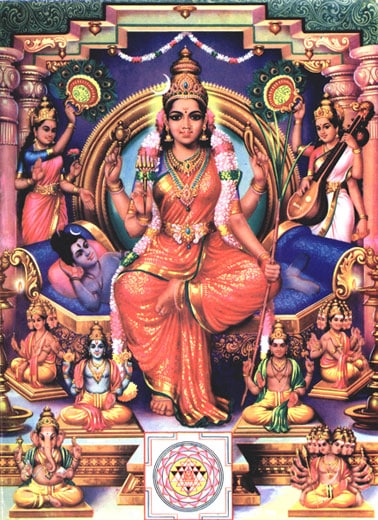
The Lalitha Sahasranama Stotram lists the thousand names of Goddess Lalitha Devi in three Chapters (320 verses) of the Uttara Khand of the Brahmanda Purana.
It draws inspiration from the Lalithopakhyana which constitutes the last four chapters of the Brahmanda Purana (Chapters 41-44).
The Uttara Khand is presented as a dialog between Sage Agastya and Lord Hayagriva, Vishnu’s horse-headed avatar symbolizing knowledge and wisdom.
The first chapter consisting of 51 verses, opens with Agastya pleading with Lord Hayagriva to teach him Devi’s 1000 names. Lord Hayagriva informs Agastya that these secret names (Rahasya Sahasranama) are supposed to be revealed to only those who are full of faith and devotion.
Since Lord Hayagriva considers Agastya worthy, he then proceeds to reveal the names by first introducing the Vaga-devatas in verse 27 of Chapter 1. These Vaga-devatas, says the Lord were inspired by Goddess Lalitha Devi to compose and recite the Sahasranama Stotra in praise of the Goddess.
In the second chapter, Lord Hayagriva, reveals the 1000 names in 183 verses.
In the third and final chapter of 86 verses, the Lord, covers the advantages of chanting the Lalitha Sahasranama by stating that no other stotra equals the Lalitha Sahasranama in merit, nor will there ever be one to equal it. He then lists all the benefits a devotee can get by reciting the Lalitha Sahasranama Stotra and finally closes by warning Agastya to never reveal it to anyone who is not full of faith and devotion.
This detailed explanation of the entire 1000 names will shine light on why this Stotra is so special and why its chanted with devotion by so many devotees.
Course Features
- Lectures 22
- Quiz 0
- Duration Lifetime access
- Skill level All levels
- Language English
- Students 22
- Certificate No
- Assessments Yes
Curriculum
- 2 Sections
- 22 Lessons
- Lifetime
- Lalitha Sahasranamam ChantingComplete Chanting of the Sahasranamam1
- Sahasranamam StotraStory of Goddess Lalitha Devi and the significance of her 1,000 names21
- 2.1Lalitha01 (Agastya-Hayagriva Dialog)50 Minutes
- 2.2Lalitha02 (Emergence of Lalitha Devi)59 Minutes
- 2.3Lalitha03 (Marriage of Kameshwari to Lord Kameshwar)70 Minutes
- 2.4Lalitha04 (War and Victory over Bhandasura)32 Minutes
- 2.5Lalitha05 (Names 1-26) (Verses 1-10)67 Minutes
- 2.6Lalitha06 (Names 27-83) (Verses 11-33)60 Minutes
- 2.7Lalitha07 (Names 84-131) (Verses 34-43)56 Minutes
- 2.8Lalitha08 (Names 132-183) (Verses 43-49)39 Minutes
- 2.9Lalitha09 (Names 184-198) (Verses 50-51)15 Minutes
- 2.10Lalitha10 (Names 199-237) (Verses 52-58)36 Minutes
- 2.11Lalitha11 (Names 238-290) (Verses 59-68)33 Minutes
- 2.12Lalitha12 (Names 291-365) (Verses 69-80)37 Minutes
- 2.13Lalitha13 (Names 366-458) (Verses 81-95)46 Minutes
- 2.14Lalitha14 (Names 459-552) (Verses 96-112)35 Minutes
- 2.15Lalitha15 (Names 553-600) (Verses 113-120)25 Minutes
- 2.16Lalitha16 (Names 601-661) (Verses 121-130)39 Minutes
- 2.17Lalitha17 (Names 662-713) (Verses 131-138)33 Minutes
- 2.18Lalitha18 (Names 714-756) (Verses 139-145)34 Minutes
- 2.19Lalitha19 (Names 757-830) (Verses 146-155)47 Minutes
- 2.20Lalitha20 (Names 831-911) (Verses 156-168)37 Minutes
- 2.21Lalitha21 (Names 912-1000) Verses (169-183)42 Minutes

Requirements
- Interest in learning and chanting Hindu Scripture
- Patience in learning to chant
- Willingness to Practice
- Spare time to practice 3 days a week for an hour a day
Features
- Easy to understand chanting led by instructor
- Ability to pause instructor chanting
- Ability to slow chanting
- Text of chant provided in pdf format
- English meaning of chant provided for better appreciation
Target audiences
- Ages 10 and over
- Anybody interested in learning to chant